Want To Train Your Staff On EMC Fundamentals For Product
Design?
NEW
On-Line Course!
EMC Troubleshooting and Precompliance Testing For Product
Designers (On-Line Learning
on
Demand)
Hosted
by EMC FastPass >>> Click here to for more information and to
register!
Details:
Price $995.
Includes six lessons totaling 5-1/2 intensive hours of
material, downloadable seminar notes, seven video demos,
personal help and coaching via email for one year.
Course Description: This
seminar covers the basics of EMC design and how to correct
typical design issues, simple pre-compliance bench top
measurement methods, and includes a number of simple
techniques and tools useful in characterizing designs at
various stages of development that will better prepare
products for EMC qualification.
The
presentation will also include video demonstrations of many
of the basic principles. Finally, several case studies will
also be described. Homework includes making simple probes,
tools, and measurement projects. The focus will be on the
top three EMI issues for most products: radiated
emissions, radiated immunity, and
ESD.
Lesson
1: Introduction to EMC, EMI & troubleshooting
philosophy
Lesson 2: Important EMC product design concepts
Lesson 3: Radiated emissions testing (part 1)
Lesson 4: Radiated emissions testing (part 2)
Lesson 5: Immunity testing (radiated, conducted, EFT,
surge)
Lesson 6: ESD testing
“EMC
Essentials” - Public or In-House Course (2-3
days)
In-House
Course:
Price $1,000/seat (minimum of six seats, plus expenses)
SPECIAL! The
following in-house course is offered through Wyatt
Technical Services, LLC Please contact me directly for
scheduling. This seminar can also be extended by a day, or
more, to include more on pre-compliance testing, including
setting up a temporary measurement range and pre-compliance
test lab. Many companies will also add a day for specific
consultation on one, or more, current projects. The price
includes my book,
EMI Troubleshooting Cookbook For Product
Designers, and
300+ pages of bound color seminar notes. Many companies
have me stay an extra day or two to help them with specific
product issues or to conduct design reviews. Extra
consulting days are my standard $2,200/day. Please request
the business policies sheet for more details and
information about arranging the seminar.
Public
Course:
Price $1,295/seat Public
courses are hosted by companies in Colorado and other
states, as demand dictates. If you’re interested in hosting
a public seminar, please call or email. Please refer to
the Seminar Schedule page
for currently scheduled dates. The standard seminar runs
for two days and includes a 300+-page set of seminar
notes. Price per seat is currently $1,295, which
includes lunches and break service.
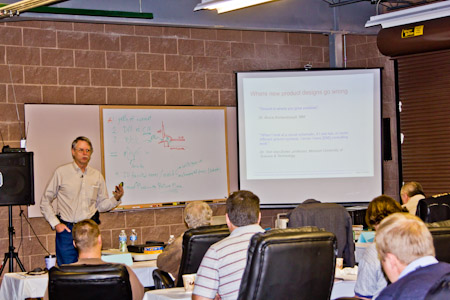
Why Attend? Because
time-to-market and budget factors often drive many of
today’s high-tech designs, electromagnetic compatibility
(EMC) issues often surface at the last moment in the design
cycle, potentially delaying product introductions. Very
often, simple pre-compliance measurements and techniques
can identify issues early when the cost of implementation
is substantially lower and design improvements may be made
with less impact on schedules. This seminar covers the
basics of EMC design, simple bench top measurement methods
and includes a number of simple techniques and tools useful
in characterizing designs at various stages of development
and will better prepare products for EMC qualification.
Learning Objectives:
Upon completing the course, the participant will be able
to:
- Analyze, measure, troubleshoot and solve an EMC problem in more detail
- Understand theory from a more in-depth view and understand causes of the top EMC issues: radiated emissions and electrostatic discharge
- Make or purchase simple low-cost bench top troubleshooting tools
- Perform simple evaluation and pre-qualification tests to ensure likeliness of compliance
Target Audience:
Analog, RF, Mechanical and Digital hardware design engineers will benefit from this course. A basic engineering background (BSEE or equivalent) is required.
Outline:
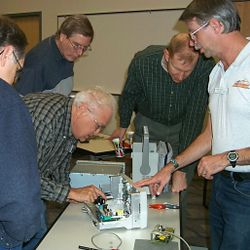
Day 1: EMC
Theory (Part 1) - Attendees will be introduced to units of
measurement, time and frequency domain, differential and
common mode currents, radiated emissions, ESD, PC board
layout and shielding/bonding. Day 1 is crucial to
understanding the Day 2 presentation, as it will also
include demonstrations of many of the basic principles.
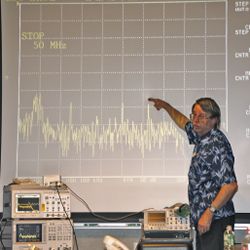
Day
2: EMC
Theory (Part 2), plus Bench Top Measurements and
Troubleshooting - We’ll continue with ESD and system
design, followed up with practical tools and techniques
that can be used for pre-compliance measurements as well as
troubleshooting EMC problems using a straightforward
process. We will demonstrate several probing and analysis
techniques that will identify EMC issues quickly. Included
in the demonstrations will be the use of real-time spectrum
measurements and the use of TEM cells for radiated
emissions and immunity troubleshooting. Several real world
case studies will also be described.
Day
3 (optional): More
on how to perform pre-compliance
testing, including setting up a temporary measurement range
and pre-compliance test lab. This could save countless time
and money by lowering the risk when attempting third-party
compliance testing. After-seminar time reserved to answer
attendee questions related to individual EMC design
problems. I’m also available to help with design reviews or
specific troubleshooting on your
products.
Testimonials:
I
really thought you did a great job teaching us about ESD
issues last month. I told my boss that your seminar
was the best I have attended to date.
Dave H.
Thx for doing the
presentation yesterday at the IEEE event in Denver. I
attended and enjoyed the content. Nick K.
And
from some anonymous evaluation forms:
Very
useful course!
Good course with lots of info!
Loved the practical tips and tricks; especially the
troubleshooting tips.
Great review of concepts. I liked the sharing of the EMI
kit and the troubleshooting techniques.
The demonstrations and the DIY tips for building and using
your own testing equipment were the best part for me.
The instructor was good…very helpful!
The demos really bring ideas to light and the
troubleshooting tips were very enlightening. Overall the
course was very good.
It was good to see EMI prevention techniques from the PC
board design phase to the finished product testing
phase.
Note:
All course material may be customized to your needs.
Contact me for details.